


Today I was trying something new while out for my morning 4km wheel around the neighbourhood. Offered a month free trial of Audible, I started Angela Reitsma Bick’s book ‘Blessed Are The Undone: Testimonies of the Quiet Deconstruction of Faith in Canada’. Honestly, I’m not a big audible book fan. I like sitting with the pages in my hand while slowly soaking in the written content. Just look at my socials and you will find an abundance of authors and quotes to which I sat with and digested. But I digress from why I am sharing this with you.
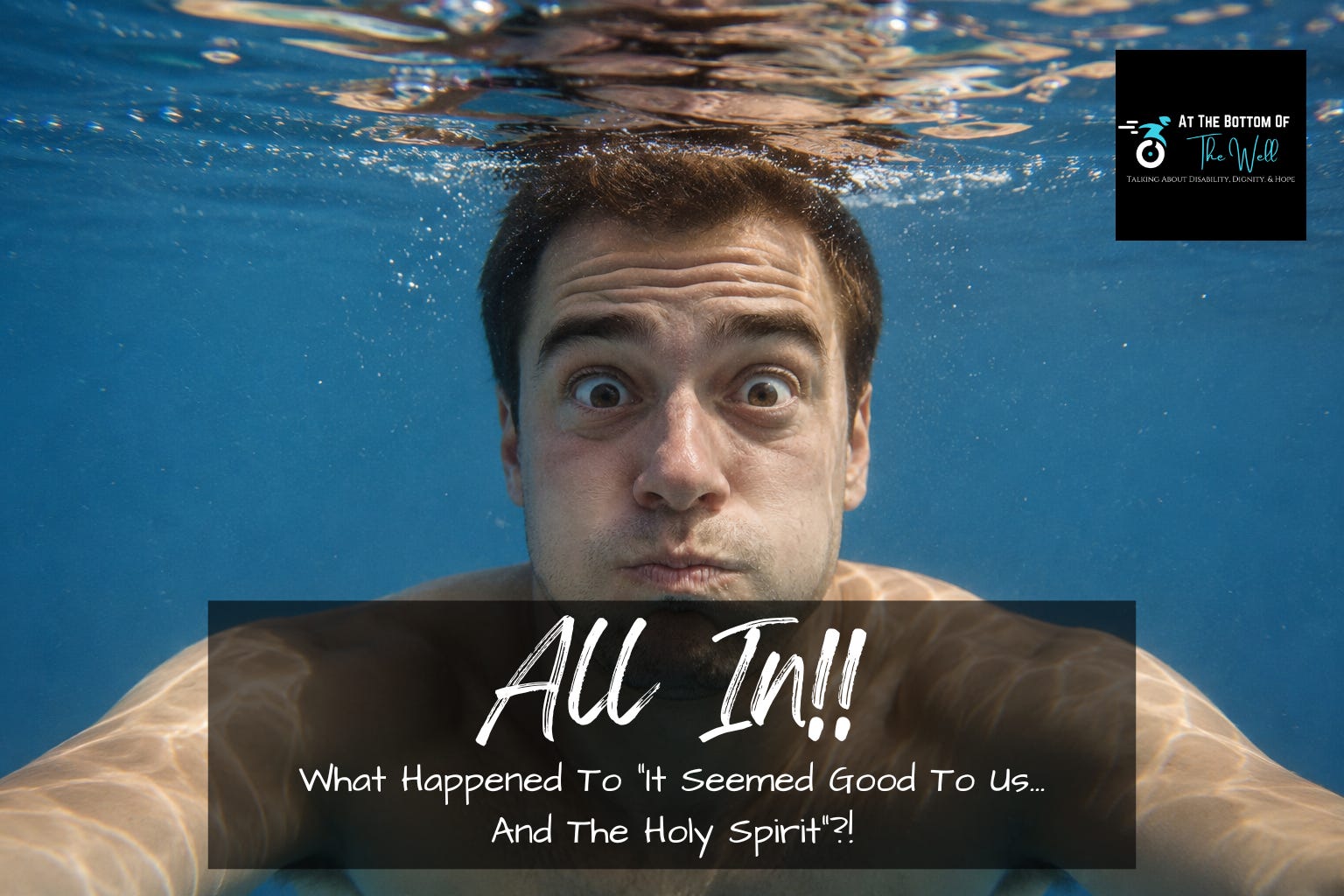
Reaching chapter 4, I was immediately grabbed by the provocative title: ‘We Were ‘All In’. I know from previous conversations with Angela that she wrote this book, and subsequently this chapter title, over several years ago with the book being published 2 years ago, itself. AND YET… in a few weeks time Terry Sanderson, is preparing to give a denominational address at the Alliance Canada General Assembly he is calling… “All In Alliance”.
I couldn’t help but connect the two phrases while wondering if this was Terry’s attempt to send some kind of metaphorical “shot across the bow” of a social (and perhaps spiritual) shift towards an ecumenical movement? In essence, “return to the status quo of the accepted ‘IN’ parameters. Or find yourself to be sent to the outskirts of the city.” Perhaps we might use another term for such liminal spaces and call it Galgotha. How’s that for metaphorical?!
Ok. So returning to chapter 4 of Angela’s book. She sets the stage beautifully for both sides of the city pendulum giving a description of the Liberal space first saying:
“To deconstruct, you need a building with walls and a roof. Liberal churches seem to have a few walls, blurred boundaries, and loose connections. Some conservative churches built their walls too high and the doors too small. What is endearing and warm — and problematic and painful — is that they are tight communities where the social fabric is thick and everyone knows everyone else. These churches turn a temporary canoe camp made into a more permanent compound with a fence.”
Having been part of a House Church movement for many years, I can identify with some of the strengths and weaknesses she articulates here. It was Richard Beck (who by the way will be my next guest on the Well Dwellers Podcast 😉) who challenged me several years ago by asking about heresy in the house church movement that left me pondering just how loosely we hold onto the gospel.
But that does not loose sight of the equally polarizing other end of the pendulum as Angela depicts the hyper Conservative vision:
“The Faith prediction of some of the undone did not think too much about environmental issues, the plate and promise of the indigenous people of Canada, or the long, checkered history of the Christian Church. Their tradition often held to a strict nuclear family ethic that champion the male/female dyad and shunned the dominant cultures swift endorsement of same-sex marriage. While none were overly racist, resisting systemic racism was not an ethical priority. Life was about church, holiness, family, and being good productive Canadian citizens. It was focussed on the Bible as the truth in text. A conservative Faith framed the family, learning, work — everything. They were ‘all in.’”
Here is where the problem lies… If all we are about is being “All In” to the ideological centres of our theological campus, we will never experience the blessings of the Spirit calling US to stretch beyond our own blindedness. As chapter 4 concludes:
“Change cannot be avoided. And alive, growing, culturally engaged. Faith cannot remain static, or it will be stunted in its constant quest for self preservation. It will suffer the pains that come with denying and avoid avoiding the issues that inevitably arise in any community. Even orthodoxy needs fresh restating and contextualizing to the cultural moment. It is our firm conviction that some sort of deconstruction is normal for growth — whether it takes the shape of falling away, repentance, or the quiet reconstruction that we call sanctification.”
Lets be real here, the work of sanctification is not meant to be easy. Its not meant to be comfortable and reconciled with a confidence of perfectionism. Its uneasy, grinding, fearfully, and wonderfully worked out through messiness and the promise of returning to new quests of metanoia and asking what transformation are we to consider next in looking like for Christlikeness?
The first Council of the Christian Church seemed to rely on the understanding that for guidance they are not looking towards Peter’s “All In” mandates. To become the community that the triune God was truly calling them to be, it had to “seem good to US… and the Holy Spirit”.
I’m no biblical scholar or expert theologian, but it seemed to me that Jesus did not consider “All In” to be the measure to live for, either”. It seems to me he was more moved by a Spirit to embody the life of being “All Out”! Ya, I think I like that more for an embodying call.
I AM ALL OUT FOR JESUS!!
If then there is any encouragement in Christ, any consolation from love, any sharing in the Spirit, any compassion and sympathy, make my joy complete: be of the same mind, having the same love, being in full accord and of one mind. Do nothing from selfish ambition or conceit, but in humility regard others as better than yourselves. Let each of you look not to your own interests, but to the interests of others. Let the same mind be in you that was in Christ Jesus,
who, though he was in the form of God,
did not regard equality with God
as something to be exploited,
but emptied himself,
taking the form of a slave,
being born in human likeness.
And being found in human form,
he humbled himself
and became obedient to the point of death—
even death on a cross.
— Philippians 2:1-8 NRSV