

Ok. Just some ramblings on something that has been stuck in my head as I see the latest social media fad.
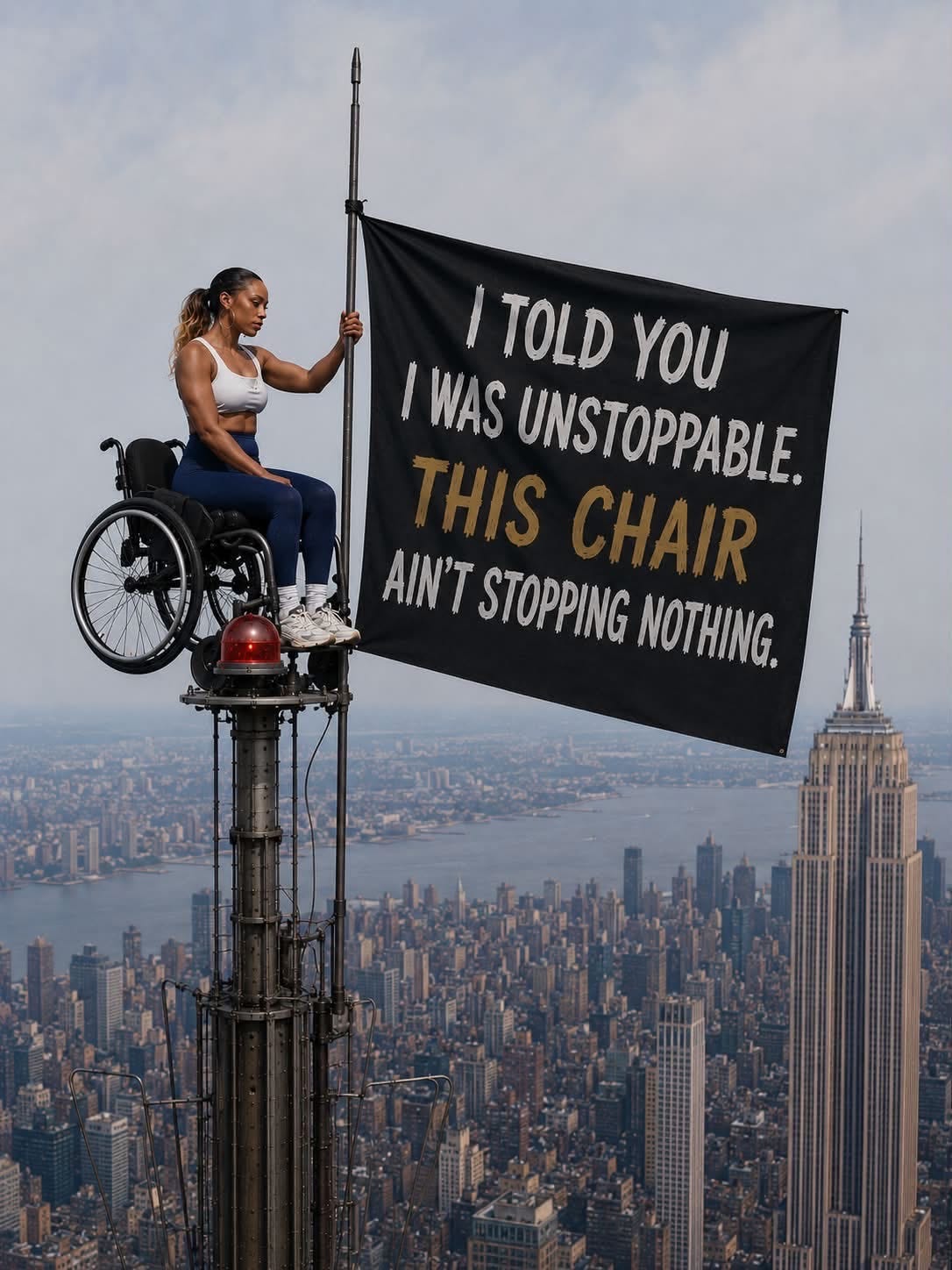
It’s not like I just saw it once. It seems like this latest AI generated photo of a person in a wheelchair who is perfectly balanced on the nose of a skyscraper, as though they climbed to the top themselves, is being shared everywhere. Can we see it as just being an image shared for a few laughs? Maybe.
But, as someone who is in a wheelchair, I find it rather annoying and reflective of a socio-cultural propagandized quip that props up an ableist belief that dis/abled people are existent for the purposes of measuring up to a degree of inspiration that proves “all things are possible”… if we are just willing to work hard enough, spend enough money, and take enough risks to defy all the odds. Essentially, there is no such thing as limitations to human abilities. At least, we would like to believe so.
Why is humanity so afraid of human limitations?
Why are the dis/abled only recognizable by inspirational accomplishment and our willingness to seek achieving ableist measures of success? That, or given a merit badge (👍🏻) for trying?
The thoughts reminded me of a conversation on hope that I had with Angela Reitsma Bick in this past season’s Well Dweller’s Podcast.1 Paraphrasing it a bit for this context, I asked her:
“What do our limitations destroy for us? And what do they create?”
Building on this, here are a few thoughts to how human limitation can actually create dignity, hope, and character in who we are as dis/abled people.
Limitations Fosters Creativity
Andrew McConnell suggests that creativity struggles to thrive when people have endless opportunities for success. He explains:
“When options are limitless, the decision-making process can be hampered by the paradox of choice. Too many options can lead to decision fatigue, less satisfaction, and a stunted creative process.”
On the other hand, McConnell believes that limitations spark innovation in life skills and personal development:
“Limitations, however, force us to explore depths and angles we wouldn't otherwise consider. They push us to look at resources and solutions right under our noses, to make do and innovate with what we have. It's a mental model that turns scarcity into opportunity.”2
After living with a spinal cord injury for over 30 years, limitations have become a natural part of my identity. They appear at different times and places, often changing in form or intensity. Sometimes, I overcome certain limitations only to encounter new ones.
Ultimately, these limitations create a focus within the boundaries of our defined abilities, encouraging creativity. This creativity can help us test our limits and discover deeper connections to the experiences and relationships we are desiring. When we stop worrying about what we can’t do, we become more innovative about what we can actually achieve. Or perhaps even why we are seeking it in the first place. After all, even our why’s can be falsely motivated by ableist assumptions. Authentic creativity is not making the impossible or unrealistic materialize or become real. As Brené Brown puts it:
“Creativity is the engine that drives integration; it helps us transform knowledge into practice. Basically, we move what we’re learning from our heads to our hearts through our hands.”3
Limitations Encourages Prioritization
Speaking of assumptions, while a limitless life offers an amplitude of options for our ambition, the reality is we cannot do all things at once. Responsible prioritization is in a constant entanglement with our moral sense of who we are and who we are becoming.
I absolutely love creative expressionism — writing, podcasting, video production, reading, movies/TV. It doesn’t take long before I get lost in the time and my priorities become out of sync. Dis/abilities also present another level of priorities that most average people do not consider or have — health requirements and care, medical appointments, exercise to maintain daily activities, time constraints because everything takes longer to get done, and relational strain from health care mismanagement.
“I’m so sick and tired of having to workout like an Olympic athlete just to get on and off of the toilet!”
— Dr. Audrey Lim [The Good Doctor]

“Midlife often heightens the feeling that there is not enough time left in life to waste.” Shahram Heshmat writes in his article from Psychology Today. I suppose I am there at 47. But scarcity of time can also be a common theme brought on by physical trauma and chronic health struggles. The dis/abled life seem fleetingly short and questions of what can actually be achieved are strained by the struggle of personal worth and mattering.
With great patience, self-grace, therapy, and a supportive community we can learn to encourage personal and communal practices of prioritization while learning a healthy acceptance of our limitations and the things that really truly matter to us. As Heshmat goes on to point out:
“We overcome the illusion that we can be anything, do anything, and experience everything. We restructure our lives around the needs that are essential. This means that we accept that there will be many things we won’t do in our lives.”4
Limitations Builds Resilience
Over the past 30 years of living in a wheelchair, I have faced countless experiences of trauma and pain, each encounter testing both new and old limitations. It has never been easy. Yet, through realistic prioritization and the lessons of lived experience, I have developed the resilience needed to navigate these shifting challenges with growing confidence.
Craig Fearn captures this mindset well in Unlocking ‘The Potential: The Power Of Realistic Thinking’:
“Realistic thinking helps us tackle today’s complex world head-on. It sharpens our decision-making skills and lets us adapt to change with ease.”5
For years, I have shared with both my disabled and abled friends that change is inevitable. It is not the change itself but rather how we navigate it—how we process new limitations—that weaves resilience into the fabric of who we are.
William Arthur Ward put it succinctly:
“The pessimist complains about the wind; the optimist expects it to change; the realist adjusts the sails.”
By choosing to adjust my sails, I have found renewed strength not in resisting change but in moving with it, turning each limitation into an opportunity for growth.
Limitations Deepens Empathy
“You therefore must be perfect, as your heavenly Father is perfect.” I must admit, these words of Jesus afflicted me greatly in my youth. It wouldn’t be until I was in my later 20’s that I began to understand that Jesus wasn’t expecting perfection in the singular role of personal achievement. Perfection comes through relational compassion, grace, and empathy. As Jesus would later tell his followers, “Apart from me you can do nothing.” Perfection is not self-sufficiency. It is dependence, communion, and love.
Franklin Murphy captures this beautifully:
“Living with imperfection invites us to celebrate our shared humanity rather than compete in an unattainable race toward perfection—a journey where true growth unfolds through acceptance and compassion for ourselves and those around us.”6
Ableism resists this vision because it teaches us to measure human worth by independence, productivity, and exceptional performance. It celebrates disabled people only when they accomplish extraordinary feats that reassure the non-disabled world — such as climbing a skyscraper, becoming an inspirational spectacle, or proving they have somehow overcome dis/ability itself. If we are not extraordinary, we are often rendered invisible. If we are visible, it is too often as the object of pity, inspiration, or comedy.
Our cultural stories reveal the same pattern. Even today, dis/abled characters are remarkably rare in film and television. Earlier I mentioned Dr. Audrey Lim from ‘The Good Doctor’. After surviving a brutal knife attack that severed her spinal cord, she became a paraplegic in a wheelchair. For a brief moment, a popular television series allowed a respected surgeon to continue her life and vocation as a dis/abled woman. Yet in an all to familiarly and painfully turn, only a few months later she underwent a miraculous surgery that restored her to an able-bodied life.7 Once again, dis/ability became something to escape rather than a way of being human.
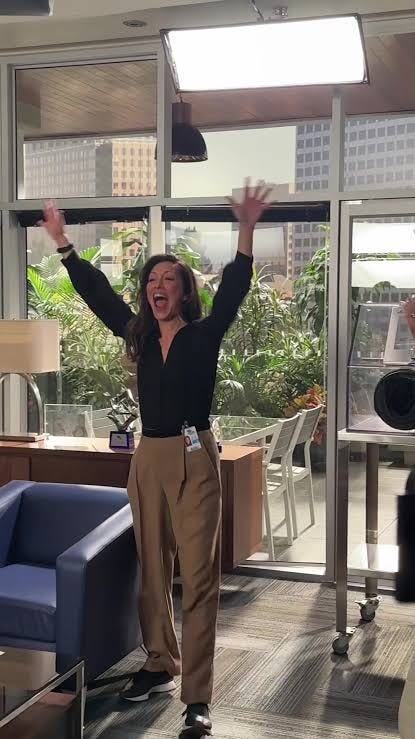
These stories and the way we treat dis/abled in our community matter, fictional or not, because they shape our imaginations and world view. They quietly reinforce the belief that the best ending is always the disappearance of dis/ability rather than the flourishing of dis/abled lives.
When we are willing to recognize human limitation—including dis/ability—not as a defect belonging to a few but as a shared reality of being human, our capacity for empathy begins to deepen. We stop asking people to become more like us in order to belong. Instead, we discover that community is strengthened precisely because our lives are different. Our shared dignity is not found in our sameness but in our mutual interdependence, where every person’s life becomes a gift to the whole.
“Implicit in the acceptance of limitations is the acceptance that whilst you can probably learn to do anything, it's probably not always efficient to do so. What this means is that we are required to collaborate with people that are both smarter / better than ourselves and people that compliments / covers our weaknesses.”8
— From An Article Titled ‘Accepting Limitations’
A Final Thought…
Recently, my friend Keith Dow wrote an intriguing post called ‘Why AI Can’t Replace Character or Presence’. Being that I started this post rambling on about an AI generated photo of a person in a wheelchair at the top of a skyscraper, I think we should close with a final thought to ponder.
Keith highlights wisely that:
“Greed and power certainly drive parts of the development, but the uptake on a societal scale, I think, comes in large part from a desire to overcome our experienced limitations.”9
Perhaps the question isn’t whether AI can generate impossible images. Of course it can. The deeper question is why those are the stories we are so eager to share and talk about.
Why does an impossible image of a woman in a wheelchair conquering a skyscraper resonate more deeply than the ordinary courage of someone navigating inaccessible streets, raising a family, building friendships, pursuing meaningful work, or simply learning to live well within the realities of dis/ability? Why are we so captivated by fantasies of escaping limitation instead of stories of flourishing within them?
AI is neither inherently good nor inherently evil — something even I struggle with at times. Like every human tool before it, it will amplify the values of those who create and use it. If our imaginations are shaped by ableism, AI will reproduce ableism as we use it. If our imaginations are shaped by dignity, interdependence, and compassion, AI can help tell those stories instead.
Our calling as image bearers of our creator is not to erase human limitation but to honour it as part of what makes us human — dis/abled or not. The dis/abled life does not need to be rewritten into a story of impossible triumphs to possess beauty, dignity, or hope. Those things are already present—in creativity born from constraint, resilience forged through change, communities strengthened by interdependence, and love deepened through shared vulnerability.
Let’s stop filling our feeds with fantasies that teach us to despise limitation. Instead, let’s tell stories that reveal the quiet strength of ordinary lives—stories that remind us that our greatest achievement is not overcoming our humanity, but learning to embrace it together in all its characters and presence!
See the full episode here:
At the moment of her being shown as a paraplegic in the show, I told my wife, “Wait and see! I guaranty you, she will be some how miraculously healed in a month or two.”

This is excellent. Thanks for sharing your wise perspective. I have send it on to a friend who is in a wheelchair due to a motorcycle accident.