
As a young boy, I remember a deep fascination with wells. I would stare into there openings, toss stones or the occasional coin into the water or rocky bottoms, and blurt out full sentences while listening to how it might echo as my voice carried down into its depths. Or sometimes, if it were one of those large shallow wishing wells, I would just capture its beautiful architecture while watching the activities of all the people around it. (For a time, I wanted to be an architect.)
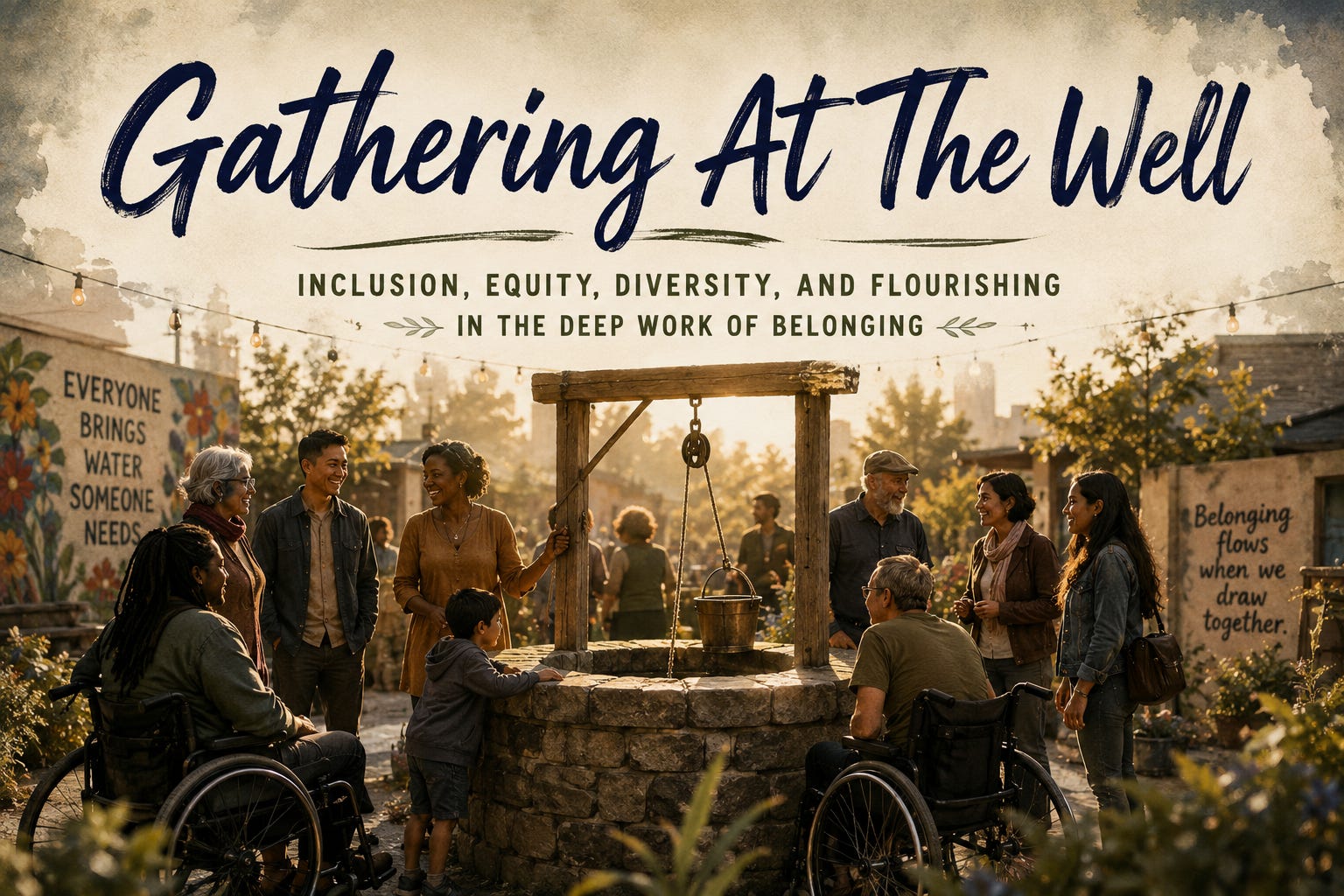
Humanity has a rich history and relationship with community wells. Meant not just as an artistic expression of beauty and rooted stability, wells offered a remembrance and source to a shared sustainable life. They were meant to be cherished while also causing us to ask the responsible questions of who is allowed to gather near it, who can draw from it, and whose wisdom and story helps protect and deepen it. Wells didn’t just get drawn from. They also drew people to them.
But wells are not always easy for everyone to find access and acceptance. People who are in the margins of life are often left out of the well space or forgotten about. They can be seen as present, but not really included or involved in the life giving activities of a well embedded life.
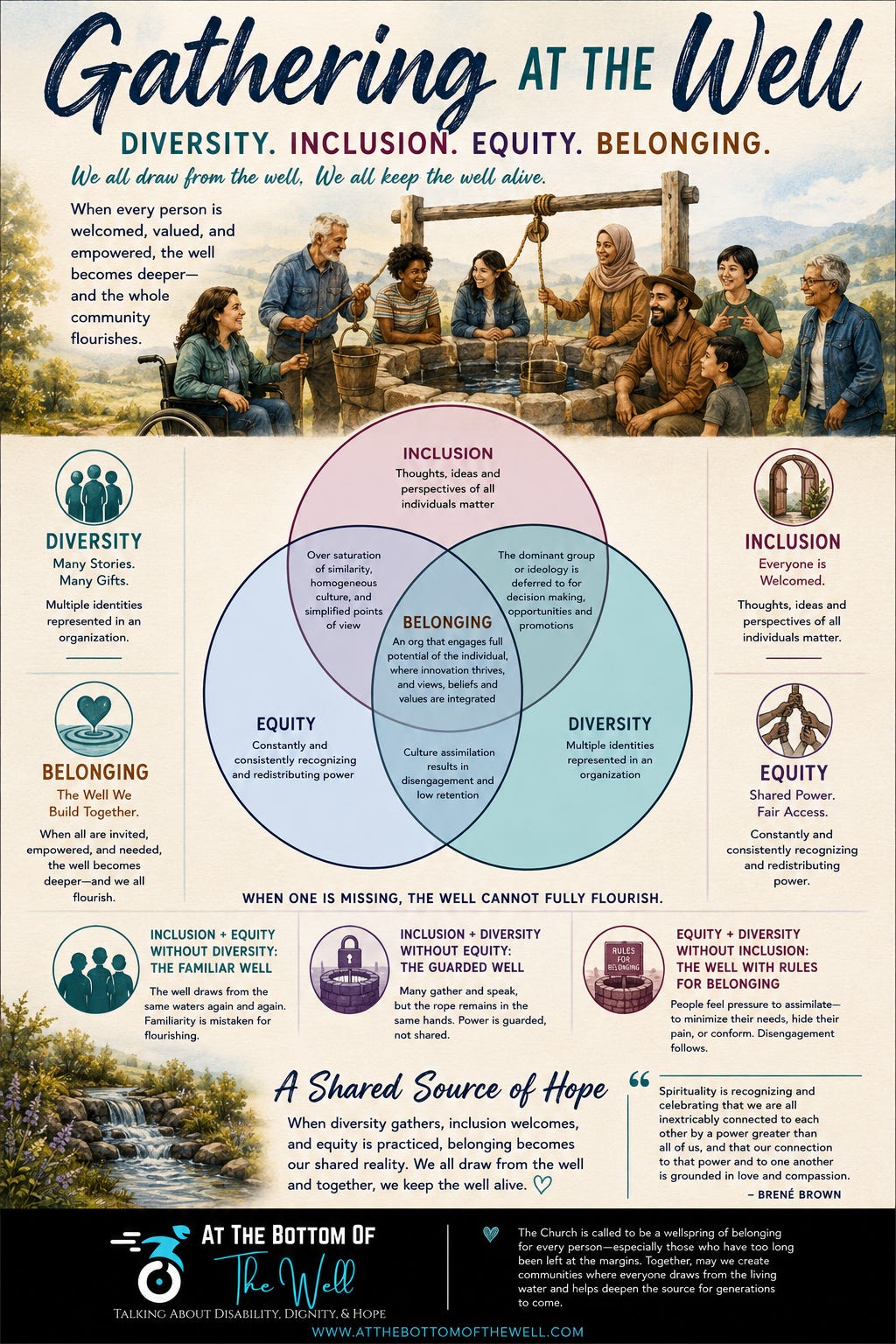
For a well centred community culture of belonging to truly flourish, it must find meaning and significance in the balance of practicing diversity, inclusion, and equity together at all times. As a well known phrase Vernā Myers's shared in a speech back in 2015:1
"Diversity is being invited to the party; inclusion is being asked to dance; equity is allowing everyone to play their own music.”
Diversity — Who’s Drawn To The Well?
As a missiologist and house church planter it’s always important to me to know who my neighbours are. Perhaps more in the practicalities of the dis/abled life, neighbours are also who we can rely on when we find ourselves in a pinch.
I don’t know what we would do without our South African friends and neighbours, Luke & Jackie. They have been there at our lowest of lows and highest of highs over the years. Everything from being a listening ear to my wife when I was kept in hospital, running errands for us if we were stuck at home, rescuing us in our van when it got stuck in snow, to hosting and celebrating Easter with our house church community in a campground, and watching movies with us in our home—these are some of the memories of building diversity in our community.
But diversity also means seeing and recognizing the gifts, talents, and presence of the dis/abled and marginalized in our community, as well. Being built fully wheelchair accessible, our home has become a hub for community life in our neighbourhood. Hosting BBQ’s, movie nights, 3 day live streamings of a online conferences to a room of 8-12 people, house concerts, and every prayer gathering and party you can imagine. One of the powers of dis/ability is having an imagination for accessibility to everybody no matter how different or diverse they are in your community.
Ultimately, diversity enlarges a community's capacity for imagination. Without it, a well may still provide water, but it can no longer nourish the fullness of real human life. Communities begin to confuse sameness with unity, overlooking the gifts carried by people whose stories, bodies, and experiences differ from the majority. In doing so, they not only exclude their neighbours—they diminish the life of the whole community.
"Conformity is not unity. Conformity is fake unity. Friends, the only way you will ever have unity is to love diversity...God made us a million different ways."
— Rick Warren in ‘This Is Going To Be An Inquisition Now’
Inclusion — Who’s Voice Is Heard At The Well?
In its simplest form, inclusion means creating a community where every person is welcomed, valued, and able to participate fully in its shared life. Within the context of dis/ability, inclusion has often been pursued through accessible design, thoughtful policies, and legal protections that ensure dis/abled people can enter spaces once closed to them.
These important steps and advances matter. They open community gates that should never have been locked. Yet inclusion cannot end at the doorways or cutaways in our community paths.
A person may be legally welcomed, physically present, and able to reach the well, while still remaining unseen beside it. Ramps and automatic doors may provide access, but they cannot, on their own, cultivate trust, friendship, or belonging. Access to the well is not the same as being received there. A community becomes truly inclusive only when dis/abled people are not simply accommodated, but recognized as neighbours whose stories, wisdom, leadership, and presence deepen the life of the whole community.
Access invites someone to the well. Inclusion welcomes them beside it. Belonging recognizes that the well is deeper because they are there.
A few weeks ago I was at the ‘Institute on Theology & Disability’s 2026 Conference’. There were so many great conversations, presentations, and people sharing over the three days. But one particular memorable workshop was presented by an African gentleman sharing about how they have attempted to practice inclusion of the dis/abled in the African churches.
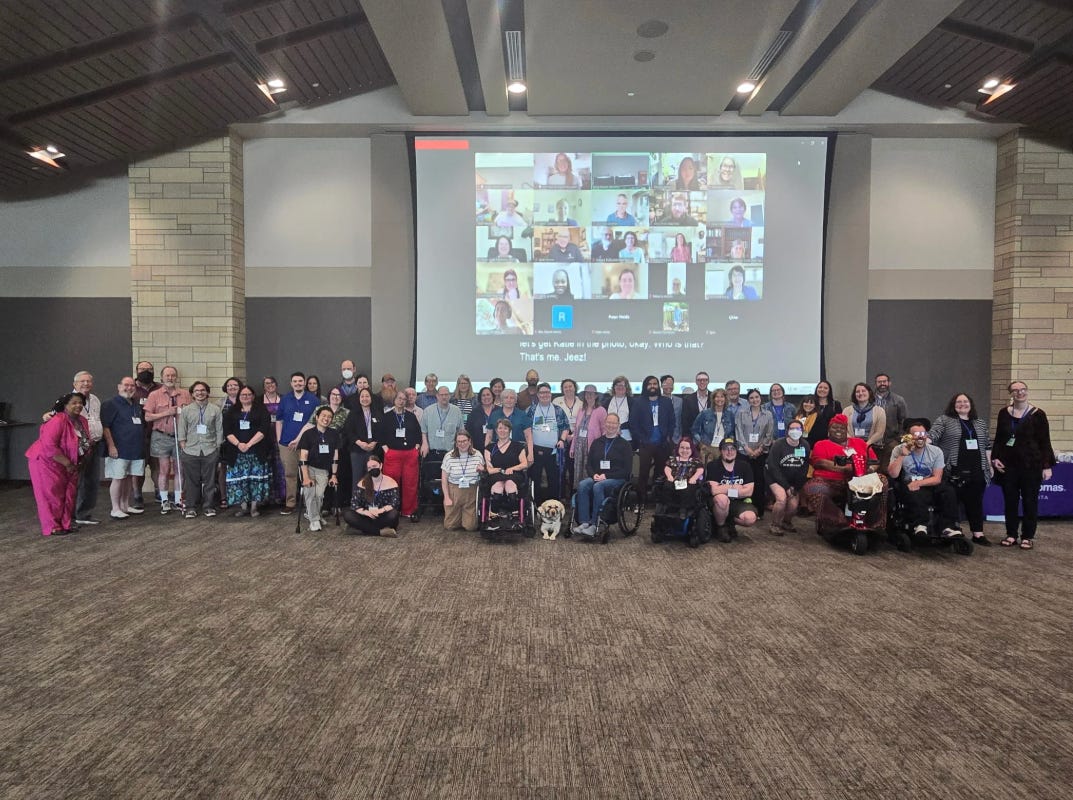
With remarkable care and theological depth, they developed a series of denominational policies that articulated what genuine inclusion could look like. I found myself commenting that this level of thoughtfulness is rarely reflected in many North American denominational statements. What struck me most was not simply the commitment to making church buildings accessible, but the vision of empowering, equipping, and cultivating the leadership of dis/abled people within the life of the church.
Yet he also spoke candidly about a painful reality. As he travelled among congregations throughout the countryside, he discovered that many churches had never implemented these policies. Some leaders were unaware they even existed. Others had never been formed by a theology of dis/ability that could sustain them or overcome the ableism already in the community. The denomination had dug a deep well of vision for inclusion, but many local communities had never learned how to draw from it. The policies remained on paper while the practices of belonging failed to take root in the everyday life of the church.
"Our potential is only reached when the full diversity of all those that make up our communities is celebrated"
— Stuart Milk in the ‘Harvey Milk Day Statement’
Equity — Who Holds The Rope?
It’s a question of power and how we share it. Who has the power to draw water? And who decides how the well is built, maintained, and shared. And by what authority are they granted this power?
As David Fitch articulated in his Substack post ‘Will We Reckon With Power?’:
“No one should question God, we say. And coercion can turn to abuse. This is why we must reckon with power, discern power, and recognize the difference between worldly power, and God’s power. Recognize the places worldly power must be engaged, and keep it within its limits.”
In my previous post, I reflected on the truth that every one of us lives with limits. The same is true of power. No single person, group, or perspective possesses everything a community needs to flourish.
Equity is not about giving everyone the same bucket and assuming the task is equal. It begins by recognizing that people encounter different barriers over the course of their life and carry different responsibilities from season to season—dis/abled or not. A flourishing community intentionally shares power, resources, opportunities, and decision-making so that everyone has the ability not only to draw from the well, but also to help tend it.
It’s important to note that for disabled members in communities, this includes decision-making authority, being recognized in the paid leadership, having and building accessible spaces, acknowledging the need for flexible participation, and the expectation that disabled wisdom helps guide the community.2 Our limits or dis/abilities are not signs of weakness; they are invitations to interdependence. Equity is the practice of ensuring that no one person's limits become the reason they are excluded from the shared life of the community.
When the Well Is Out of Balance
These three elements of a culture of Belonging are always engaging with one another, overlapping, and shifting with the tensions of organic community movement. We must always be willing to access how we are balancing these three while not letting one element take priority over the other.
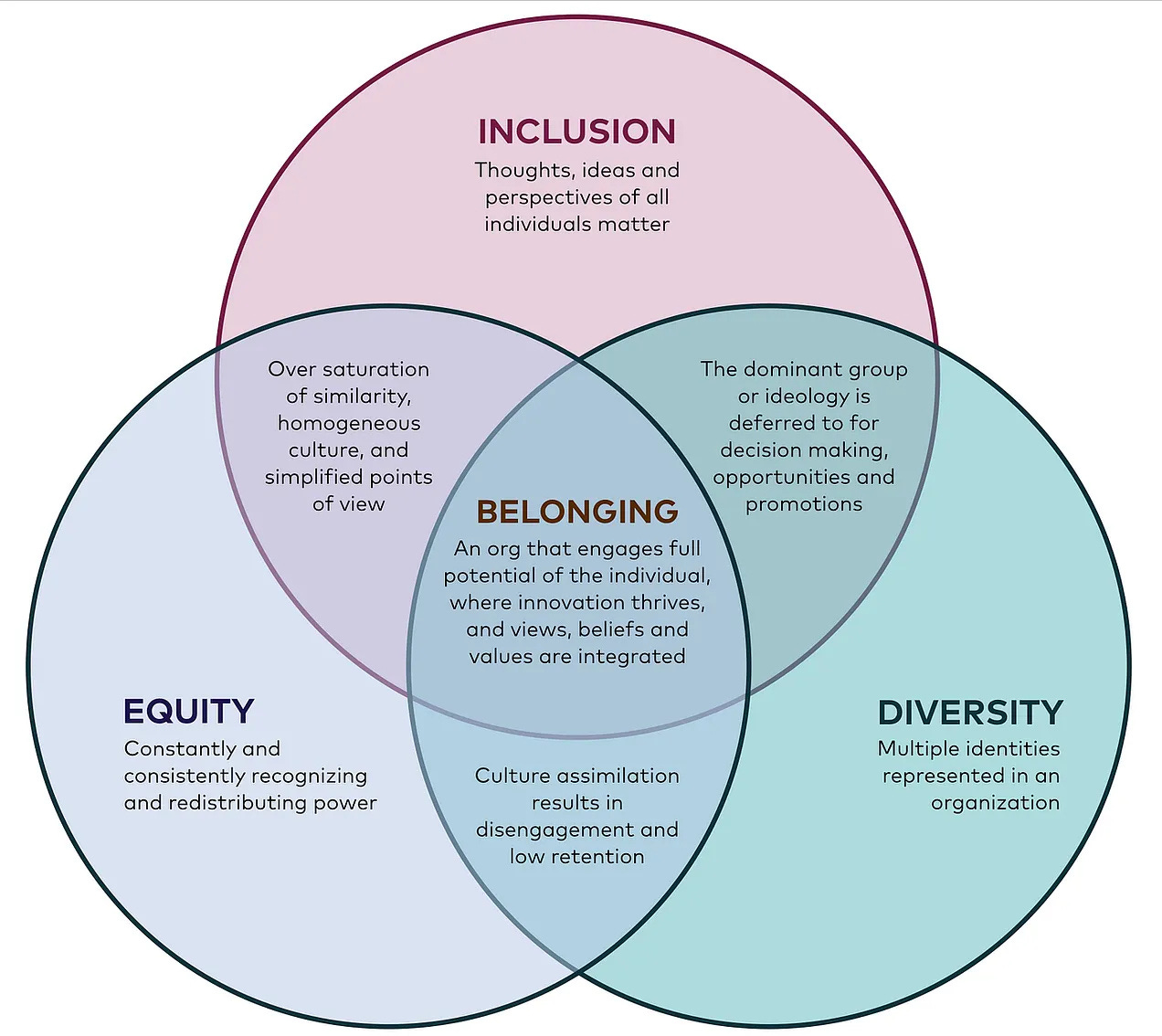
When these three—Diversity, Inclusion, & Equity—stray out of the centralized equilibrium, they can create 3 danger zones:
Inclusion + Equity Without Diversity: The Familiar Well
The people gathered at the well may genuinely care for one another. They may share leadership, resources, and opportunities with fairness and dignity. Yet when only a narrow range of experiences, perspectives, and identities is present, the well draws from the same waters again and again. The community mistakes familiarity for flourishing, and its imagination slowly grows shallow.3
Inclusion + Diversity Without Equity: The Guarded Well
The well is kept crowded and busy with the hustle and bustle of activity and people. Many people gather, many stories are shared, and many voices are heard. Yet the rope of authority remains always in the same people’s hands. The dominant group still determines whose ideas shape the future, who is trusted to lead, and who is invited to draw deeply from the community's life. Diversity is welcomed, but power remains carefully guarded.4
Equity + Diversity Without Inclusion: The Well w/ Rules For Belonging
The well is accessible, and a diverse variety of people are invited to help care for it. Yet an unspoken set of rules or cultural formation determines who truly belongs. People feel pressure to minimize their needs for the false appearance of independence, hide their pain or the chronic health conditions they grapple with every day, or reshape their dis/abled identities to fit the culture already in place. Diversity may be visible, and equitable power may be shared, but belonging remains conditional to conformity. Eventually, many stop drawing from the well—not because they are unwelcome, but because they have grown weary of pretending to be someone they are not.5
Belonging: A Well Deepened by Every Person
Brené Brown writes:
“Spirituality is recognizing and celebrating that we are all inextricably connected to each other by a power greater than all of us, and that our connection to that power and to one another is grounded in love and compassion.”
There is something deeply biblical in her words. At its heart, a culture of belonging is the lived experience of that connection. It is more than being welcomed into a community or invited to participate in it. It is discovering that our lives are intertwined together, that each person’s flourishing—dis/abled or otherwise— is woven into the flourishing of everyone elses.
This is the sacred story God has been telling from the beginning. Through Christ, God is not merely gathering individuals into the same space and calling it church, but reconciling the whole of creation to himself and to one another. Belonging is the fruit of that reconciling work. It is the recognition that we are incomplete apart from one another and the gifts, stories, and presence of our dis/abled and non-dis/abled neighbours.
A flourishing well embodies this vision. Diversity gathers around it. Inclusion ensures every voice is received beside it. Equity places the rope in shared hands. Belonging, however, deepens the well itself and springs up fresh water.
When dis/abled people are welcomed not simply as recipients of care but as leaders, teachers, neighbours, artists, pastors, parents, theologians, and friends, the entire community drinks more deeply from the living water God provides. Their gifts, questions, creativity, resilience, and wisdom do not merely benefit the community—they become part of its shared source of life.
The living water overflows both to and from every person gathered at the well. Each of us arrives thirsty. Each of us leaves refreshed. And each of us bears the shared responsibility of tending the well so that those who come after us will discover that it is deeper because we gathered there together.
Practices for Tending the Well
When you consider how your church or community might foster a greater depth of belonging for those who are dis/abled, consider these practices:
Ask disabled people how the well is experienced—not only whether they can reach it with accessibility.
Include disabled people in planning activities, events, and gatherings before decisions are made.
Share leadership, resources, and compensation.
Build accessibility into the community’s ordinary rhythms.
Make room for different bodies, communication styles, energy levels, and ways of participating.
Continue returning to the question: Who is still standing at the edge, thirsty?
Closing: A Shared Source of Hope
This is the kind of community I have long imagined and hoped for—a well where every person is welcomed, every voice is valued, every gift is needed, and every life helps deepen the shared source from which we all draw.
It has been my experience that the Church still has a lot of work to do before it fully embodies this vision. Too often, our wells have been difficult to reach, carefully guarded, or shaped by assumptions about who truly belongs and in what condition. Yet I always remain hopeful because the story of God has always been one of restoring what has been segregated or marginalized, gathering those who have been scattered or unseen, and inviting every person into the abundance of life together.
If we all—dis/abled and abled—have the courage to keep tending the well—to embrace diversity, practice inclusion, share power through equity, and nurture a culture of belonging—I believe God will continue to fill it with living water. It will become a place where compassion overcomes fear, justice replaces exclusion, and hope is renewed in every relationship.
So let us keep gathering at the well. Let us draw deeply from its waters, learn from one another’s lives, and discover that the well is richer because every person has helped deepen it. For in the kingdom of God, belonging is never a gift offered by just a few able bodied individuals. It is the shared life we create together as we drink from the same living water. A culture of belonging flourishes when diversity gathers at the well, inclusion listens beside it, and equity places the rope in shared hands. Then the water is no longer controlled by a few or offered as a favour. It becomes what it was always meant to be: a shared source of life for the whole community.
This is an important issue with church membership and practice, too. Disabled wisdom is also interlinked with discipling Disability Theology—its not just for the disabled! It is for the benefit and blessing of the whole community & leadership.
I couldn’t help but think of the Evangelistic slogan, “Are you Born Again?” While scripturally connected to the question Jesus asked Nicodemus in John 3, the weight of that moment has become moot and/or without meaning or significance due to the loss of Evangelicalism’s presence in the marginal communities of today’s society.
Today’s conversation on what is Orthodox and what is not is primarily in the vein of this danger zone. If Orthodoxy is always kept through traditional hands of authority maintaining a status quo of what has always been “acceptable” and what is not, a culture of belonging is kept at bay from flourishing in the community. See David Fitch’s post: Two Kinds of Orthodoxy?
Amy Kenny’s book ‘My Body Is Not A Prayer Request’ taps into this zone. Many dis/abled choose to leave the church or remain unseen from a distance or online so as not to “disrupt” the smooth flowing professional culture of the church community.