


The following is a post written originally by me as a guest writer for our home church, the First Alliance Church in Calgary. You can see the original post here.
Not too many people know this about me, but prior to my spinal cord injury, I nearly became a lifeguard and spent a lot of time swimming in the Calgary public pools. However, that was over 30+ years ago and to be honest, I’ve never had the courage to get in a pool or visit one since!
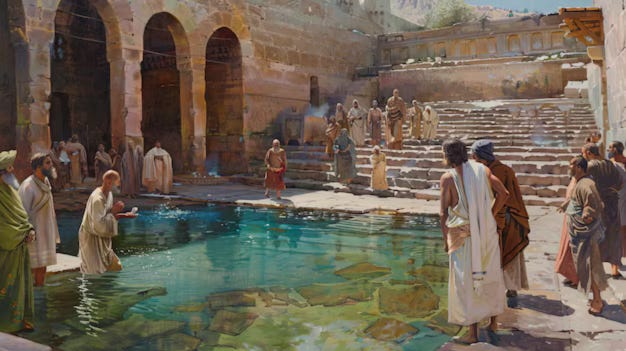
There really are not very many accessible pools in the city, either. But that is truthfully just an excuse. Those of us in the dis/abled crowd know where the cool places to take a dip are; and the venturesome one’s of us have dove right in. Of course, those pools are open for any able person to join in the fun, too. Which opens the door to reflecting on when Jesus and his friends visited a similar community pool.
Yes, it might be a funny thing to say but, the dis/abled crowd in Jesus’s time had a similar place to hangout called the pool of Bethesda. Like today, “a great number of disabled people used to lie there.” (vs. 3) Intriguingly, you must note the generalization here of the labeled “disabled” in Jesus’s story; they are glazed over as a collective and overlooked as a crowd despite John articulating their unique characteristics – the blind, the lame, and the paralyzed. Even in saying this, most of us read these qualities as a loss or negative to their character recognition as appose to their gifting and empowerment. If this seems like a stretch, think of a similar story a few chapters later when Jesus says a blind man was born blind not because of a fault, but “so God’s glory might be seen in him.” (John 9:3)
In the midst of this story and crowd, we have to ask ourselves, “What were these people really looking for in the traditions of this pool of healing and God’s work?’ And “Why did they feel so invisible to the greater community around them?” For Jesus, this moment at the pool was not merely a place to perform a miracle. It was a moment for Jesus to model seeing the dis/abled while confronting cultural invisibility, redefine personal wellness, and to unveil God’s work that continues through us even today.
I. Jesus Saw the Man — Removing Invisibility with the Sight of Incredibility
“Jesus saw him there…” (vs. 6) We’re not really sure why Jesus focused in on this particular man. But he was drawn to him out of some desire for personal connection. I’d like to think his motive was not one of despair or pity, but rather a lighthearted passion to truly draw closer and find relationship with the giftings this man would reveal.
More often than not, dis/abled today are seen as a marginal group, small in number. We don’t realize that in Alberta, 27% of our population are considered dis/abled. That is nearly 1 in 3 of us! Look around our church community. Do you see the dis/abled around our activities? Does it reflect this kind of representation or presence? Why or Why not?
For those of us that are seen and recognized, it is more often because of particular visible labels or structures – wheelchairs, walkers, or characteristics that segregate us to the “disabled” sections and ministries of the church. We are seen and known not as persons, but as conditions and for our locations or needs (disabled… parking, seats, events, caregiving). Our gifts are reduced to the disabled pools of society while otherwise invisible to the greater ethos and involvement with the Christian community.
As Jesus entered these pool areas, he saw and brought a restoration of personhood to the dis/abled people first before any understanding of healing. He did not ask what he could do. He asked what he could learn. He removed their invisibility and gave sight to their incredibility.
“See, know, discern, unveil… Sight precedes morality.” Richard Beck articulates. “For how can you take proper action in the world if you are blind, lost, deluded, ignorant, or confused? As Jesus said, the blind lead the blind, and all fall into the pit. Vision is required for navigation.”[1]
II. A New Meaning of Wellness — Empowerment, Not Erasure
“Do you want to be made well?” (v. 6) The question seems to come in simple form. But the complexity is quickly revealed with the dis/abled man’s response – a response that also shows the deeper desire he was looking for.
“I have no one…” A reply that reveals his deep sense of community isolation, exclusion, and lack of access. These feelings had been pressed into him for so long without wanting to break the religious traditional rules and boundaries, nor the social order of acceptability, that he simply laid there waiting for 37 years!
I find it intriguing that Jesus did not name healing as the man’s desire. But rather he used the words “made well”, as in well-being and the state of comfort, joy, and wholeness. Jesus redefined the dis/abled man’s restoration not as the religious or social order did – the need for a cure so that he might look and act like everyone else. He removed the shame of his cultures cure narrative and empowered the personal agency or identity in this man, so that internal self-dignity was established, a participation in life involvement was in his own rising, responsibility was given to his own recognized calling and passions, and a voice of testimony to reflecting the work and presence of God in his life was revealed as he did not throw away the mat, but picked it up and carried it with him. Jesus reveals wellness as restored belonging within God’s renewing work—not mere physical normalization to the community’s expectations or measures.
As someone who lives his life in a wheelchair, I cannot help but feel the incredible weight that must have been lifted from this man’s soul after 37 years. I do not need to feel shame nor responsibility for the ostracization of the ways my wheelchair has shaped my life. I carry it with me as evidence to my testimony and empowerment while the responsibility and work of recognition to my well-being falls not to myself, but to the community and church around me.
What are the experiences and relationships that bring these moments of well-being to you?
How might Jesus and his community empower such wellness?
Can we recognize these as the very works and miracles of God around us?
III. The Work Is Still Ongoing
As we read the story of the man at the pool of Bethesda, it is important for us to acknowledge the living Word being spoken. This is not a one-off miracle that has been performed to establish Jesus’s authority in that moment alone. It is a revelation of divine rhythm that carries on in his calling of each one of us today.
Modeling the Way for us, Jesus shares with the religious leaders around him, “My Father is still working, and I also am working.” (vs. 17) The actions and social justice work of God continues throughout history as we seek to liberate and raise the well-being of the dis/abled and excluded within our neighbourhoods and world. “For we are God’s servants,” as Paul tells us. “…working together; you are God’s field, God’s building.” (1 Cor. 3:9)
The church is called not just to pray for healing but to dismantle pools of exclusion.
We are to ask:
Who lies waiting in our sanctuaries and gathering spaces?
Who waits for access to events, retreats, and for community activities?
Who has been told to wait for a miracle while we refuse to move or change because it is easier to just continue with the normal activities?
The “Dis/abled God” Is Still Enabling His Church To Be Miraculous
The miracle at Bethesda did not begin with a man that was walking. It began with him being seen.
Before he stood, before he carried his mat through the streets, Jesus restored something even deeper than his muscle strength—he restored his dignity. In a world that had learned to step around him and not see him, Christ stopped. In a culture that had categorized him, Christ conversed. In a system and ideology that kept him waiting, Christ worked.
Nancy Eiesland reminds us that in the resurrected Jesus we meet “the dis/abled God”, a Saviour who still bears wounds. The scars and wounds were not erased in his resurrection; they were revealed as part of his glory. And it changes everything. It tells us that God’s work is not about erasing or curing dis/abled bodies or displaced lives, but about unveiling their belovedness, well-being, and belonging within the kingdom and within this world.
“My Father is still working,” Jesus says.
The question is whether we are.
Will we become a community where no one whispers, “I have no one”?
Will we dismantle the pools of exclusion we have grown comfortable maintaining?
Will we see dis/ability not as a detriment or need, but as a gift, a blessing to our community and to our lives?
Because the work that began at Bethesda continues wherever Christ’s body refuses invisibility and instead chooses the sacred, disruptive act of sight.