


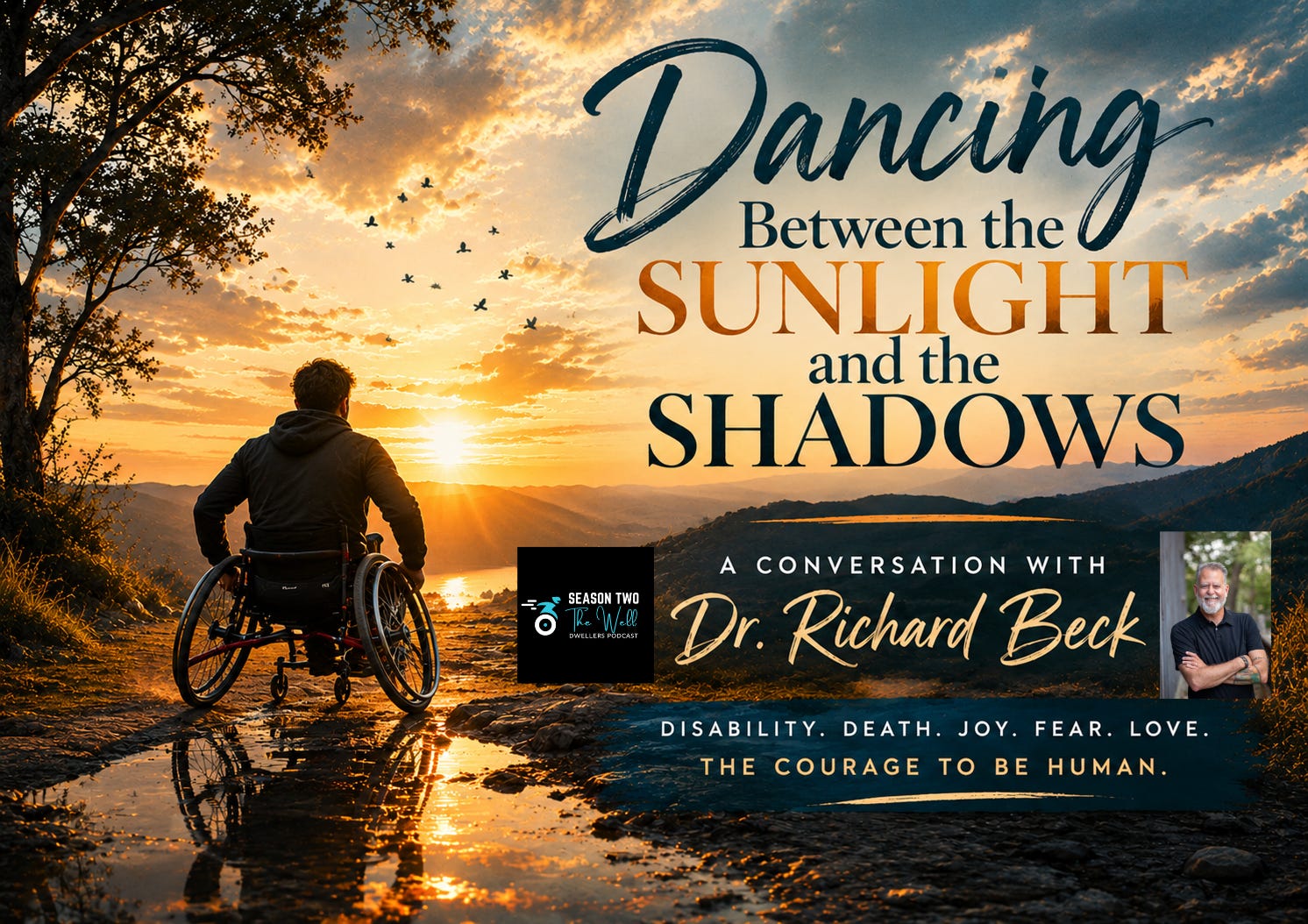
There are some conversations that feel less like interviews and more like sitting beside someone at the edge of a deep well, lowering buckets into places you do not usually allow yourself to look.
My conversation with Dr. Richard Beck was one of those encounters.
I first met Richard years ago while completing my Master’s degree under the guidance of my professor and friend Dr. Mark Love. Even then, Richard carried a way of speaking that refused easy answers. His work has always lingered around the edges of fear, mortality, desire, shame, joy, and the strange human habit of hiding from our own vulnerability. His books — The Slavery of Death, Unclean, The Shape of Joy, and now The Book of Love — have consistently challenged me to reconsider what it means to be human in a culture obsessed with control, success, and certainty.
This conversation felt especially personal.
As someone living with disability, I often find myself navigating the tension between suffering and meaning, endurance and hope, frustration and joy. Richard’s work gave language to realities I had felt for years but struggled to articulate — especially the ways fear quietly shapes both our theology and our social imagination.
At one point Richard says:
“We become radically inhospitable to bodies or lives or experiences that bring finitude into view.”
That sentence stayed with me.
Because disability often functions as precisely that kind of interruption. It exposes the illusion that independence is ultimate. It unsettles the modern obsession with optimization, productivity, and bodily perfection. It reveals how deeply both church and society are discipled by fear — fear of weakness, fear of limitation, fear of dependence, fear of death itself.
And yet, this conversation is not merely about critique.
It is about what becomes possible when we stop running.
Throughout our dialogue, Richard reflects on the “unholy trinity” of Satan, sin, and death — not primarily as abstract doctrines, but as forces shaping everyday human existence through anxiety, scarcity, self-protection, and accusation. We explored how ableism often emerges not through overt cruelty, but through hidden assumptions embedded in systems, architecture, theology, and culture.
In one of the most striking moments of our conversation, Richard described ableism as a kind of invisible accusation:
“The invisible assumptions rank bodies in a hierarchy of worth or consideration.”
That naming felt painfully true.
But there were also moments of profound beauty.
As we discussed suffering, resurrection, and the disabled experience of endurance, Richard offered words I have not stopped thinking about since:
“How do I dance between the sunlight and the shadows of that mixed experience?”
That may be one of the most honest descriptions of disability, grief, and even human existence I have ever heard.
Not triumphalism.
Not despair.
But dancing between sunlight and shadow.
We also explored the church’s failures — especially its tendency to rush too quickly toward healing narratives, resurrection fantasies, or inspirational clichés that bypass the lived reality of disabled people. Richard gently but honestly challenged this instinct:
“People quickly reach for heaven… without sitting with ambiguity, pain, and suffering.”
And perhaps that is where this conversation ultimately lands: not in certainty, but in wonder.
What if joy is not the absence of suffering, but a posture toward reality?
What if healing is larger than cure?
What if disabled lives are not problems to solve, but prophetic witnesses calling the church toward a deeper humanity?
What if the good news is not escape from finitude, but discovering that love can still flourish within it?
Toward the end of our conversation, Richard reflected on the church as both broken and beautiful — often inhospitable, often fearful, yet still capable of becoming something holy when people make room for one another in honesty and love.
He said:
“The disabled community functions to point us toward that horizon that we’re all trying to chase.”
I think he is right.
And perhaps that horizon is not perfection, normalcy, or independence.
Perhaps it is communion.
Perhaps it is learning how to belong to one another inside fragility rather than beyond it.
Perhaps it is discovering that even here — in weakness, ambiguity, grief, and unfinished stories — joy still takes shape.
I hope this conversation encourages you as deeply as it encouraged me.
Welcome back to the well.
Chapters:
00:27 Meeting Dr. Richard Beck
06:06 The Anti-Trinity & The Fear of Death
13:50 Hospitality For Finitude
17:59 Ableism Incarnated As The Accuser
25:12 Sin & The Conditions of Entrapment
33:01 The Myth of the Quick Fix & The Endurance of Time
44:07 Transcendent Joy & Hero Games
54:51 Looking For The Good News In Disabled Discipleship
01:01:41 Closing With Outward Hope
Resources:
Saunders Centre For Joy & Human Flourishing: https://acu.edu/library/saunders-center/


