


[Recording/Video Disclosure: There are moments of echoing in the audio which also disrupt the subtitles in the video from necessarily always being correct. I’m still learning how to be a better Podcaster! Thank you for your grace! And my apologies!!]
There are moments in life when the stories we’ve inherited no longer seem to fit the lives we are living.
Sometimes it is an unexpected diagnosis. Sometimes it is the trauma grief or injury. Sometimes it is exclusion by the very communities that taught us what we thought belonging should look like. Sometimes it is watching institutions we once trusted struggle under the weight of certainty, power, and performance. Whatever the catalyst, many of us eventually arrive at a place where our faith feels less like something we possess and more like something that is quietly unraveling within… and/or around us.
For generations, we’ve often been taught to fear that unraveling.
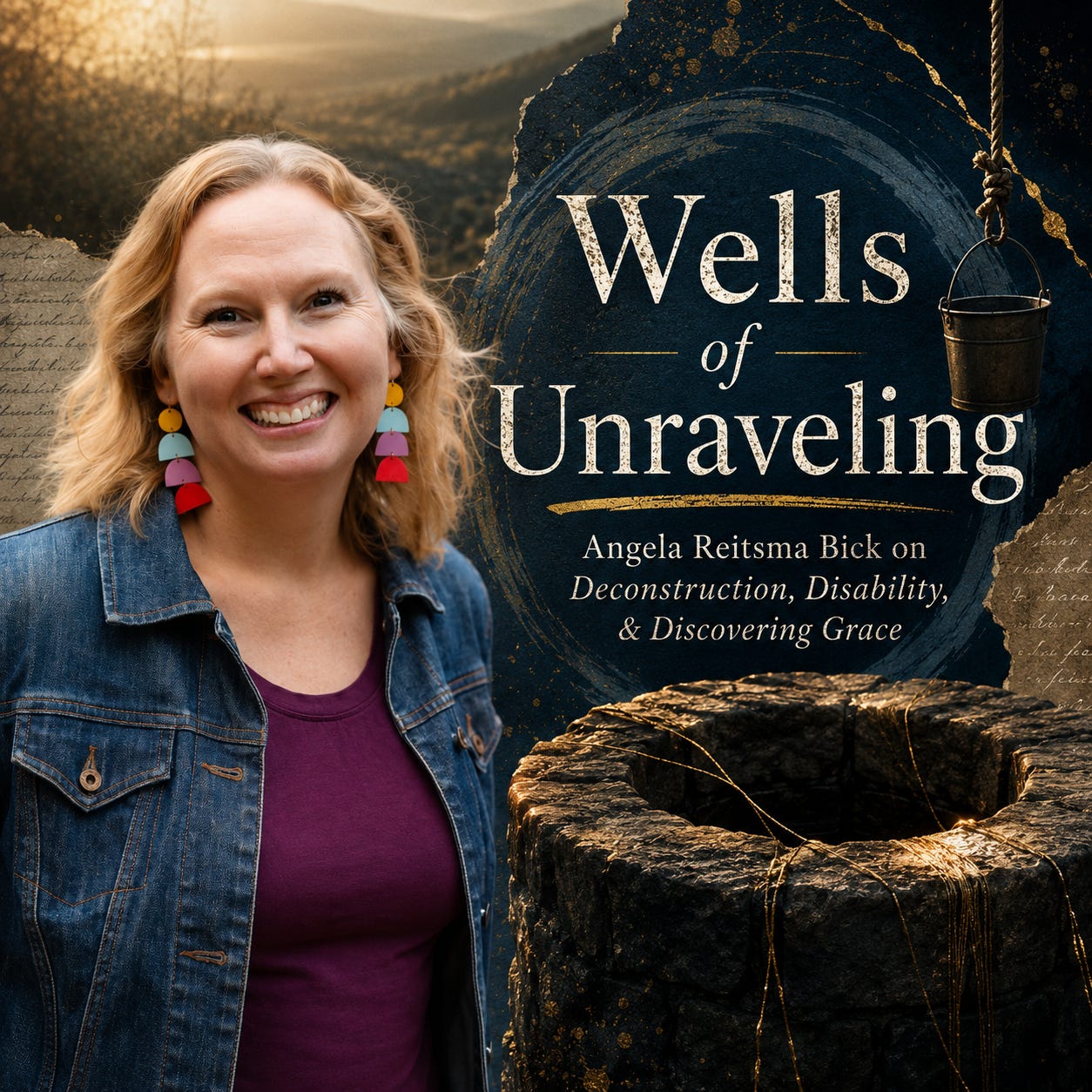
Angela Reitsma Bick invites us to see it differently.
In Blessed Are the Undone: Testimonies of the Quiet Deconstruction of Faith in Canada, she and co-author Peter Schuurman offer a profoundly hopeful vision of what happens when certainty gives way to honesty. Rather than treating deconstruction as failure, Angela describes it simply as “faith undone.” It is not necessarily the end of belief, but perhaps the beginning of a more truthful one.
As she says in our conversation:
“Deconstruction is normative... it’s actually needed.”
Those words stayed with me long after we finished recording.
In retrospect following our talk I realized even more deeply that for those of us in the disabled community, being “undone” is rarely just a metaphor. It is often the reality of living in systems that were never designed with us in mind. It is learning to navigate exclusion while still longing for belonging. It is carrying grief and hope together. It is discovering that dependence is not weakness but part of what it means to be human. It is a life of sacred unravelling.
Perhaps that is why Angela’s work resonated with me so deeply.
Throughout this conversation, we explore what it means to become undone without losing ourselves. We wrestle with the church’s fear of deconstruction, the relationship between disability and spiritual formation, prophetic imagination, reconciliation, justice, and the quiet ways God continues to meet people whose lives no longer resemble the stories they once believed.
One of my favourite moments comes when I ask Angela whether undoneness is a form of grace rather than failure.
Her response is one I hope lingers with you also:
“We deliberately paired undone with the hopeful word blessed. Even though the process of being undone is painful, it is still a chance to experience blessing... the kind of blessing Jesus offers in the Sermon on the Mount.”
That distinction matters.
Not a prosperity gospel blessing.
Not a polished, Instagram-ready faith.
But a blessing that forms humility, compassion, and deeper dependence upon God and one another.
Later in our conversation, Angela reflects on Isaiah’s declaration, “Woe is me, I am undone,” reminding us that Scripture consistently portrays people who encounter God not through triumph but through disruption. Jacob leaves his encounter with God limping. Israel learns to rebuild while living in exile. Again and again, blessing emerges not despite brokenness but within it.
I found myself wondering whether that pattern also names something essential about the disabled experience.
Perhaps disability does not simply expose our vulnerability.
Perhaps it reveals something true about all humanity.
Not that we are all somehow dis/abled by definition. And not that interdependence is a defect to overcome. But that dis/ability is part of God’s design for creation and reconciled through a story of unravelling to who we are to become in this world and the next.
That is a vision of the Gospel our churches desperately need to experience, live, and embody.
One of the convictions I carried away from this conversation is that the Church needs more stories from disabled voices—not because our experiences are separate from everyone else’s, but because they illuminate the Gospel in ways many have never been invited to see. Our stories are not peripheral to the Christian imagination; they help enlarge it.
If you have ever felt yourself questioning...
If your faith has become quieter than it once was...
If certainty has given way to curiosity...
If you have lived in the tension between exclusion and belonging...
Or if you simply long to discover a faith spacious enough to hold both lament and hope...
...then I think you’ll find yourself somewhere in this conversation.
Perhaps becoming undone is not the opposite of faith.
Perhaps it is one of the ways Christ gently remakes us.
I hope you’ll join Angela Reitsma Bick and me as we dwell together at the bottom of the well.
Chapters:
01:08 Beginning an Adventure
10:01 Undoneness & Sacred Unravelling
19:49 Deconstruction & Places of Exile
22:56 Suffering & Sufferers
25:04 Healing, Erasure, & Learning from Dis/abled Bodies
32:45 Practices of Community & a Culture of Belonging
37:46 Inclusion or Belonging?
41:51 Jesus as the Shepherd of the Undone
45:26 Contemplation Within Activism
48:54 Who’s Responsibility is it for Shaping the Dis/abled Spiritual Life?
52:47 Intersections with the Indigenous & Reconciliation Story
57:44 Jesus Therapy
1:00:52 Undone & the Myth of the “Normal Body”
1:04:32 Hope That Creates vs. Hope That Destroys
1:14:10 New Adventures Unravelling on the Horizons
Resources:


